


_________________________________
Introduction
Wang, Xiangwei, a leading local commentator, posed a central question following the announcement that Hong Kong is set to formulate its first five-year plan:
“Can a city that has long prided itself on light-touch governance and market reflexes execute a whole-of-society planning process without the institutional muscle, the technical bench, or the political habit of doing so?” (see: https://amchamhk.online/can-hong-kong-adopt-a-five-year-plan/).
This is a fair question. We need to remember, however, that Hong Kong is well-placed to draw on many decades of successful forward planning experience, stretching back to the 1950s.
Moreover, China’s latest Five-Year Plan is being bedded down just as Beijing reconfirms a remarkable, nascent insight George Orwell offered in 1945, when he implicitly wondered if China might develop a rather different perspective on global interaction compared to that favored in the West.
British Hong Kong: A free-market economy underpinned by striking public intervention
The active embrace of free market principles in British Hong Kong after World War II, first celebrated by Professor Milton Friedman around 70 years ago, was eventually given the name “positive non-interventionism” in 1971, by the Hong Kong Financial Secretary, Philip Haddon-Cave (building on the work of his predecessor, John Cowperthwaite). Friedman regularly cited Hong Kong as his favorite economy. He marketed Hong Kong as a type of free market Shangri-La in his 1980 book and TV series, “Free to Choose.”
In fact, massive government intervention in the Hong Kong economy was well underway by the time Friedman first visited.
The initial decision to build high density public rental housing was impelled by a crisis created when a terrible fire devastated a large squatter settlement. This emergency response soon evolved into a well-planned, huge, exemplary public housing project that remains in place today.
Other vital, long-term, planned interventions included the development of Hong Kong’s world class public transit system and new airport, its remarkable educational expansion, its first-world health care infrastructure, and extensive mechanisms for coping with annual weather-crises.
Friedman paid limited heed to these fundamental, interventionist realities as they got in the way of his evangelical free market advocacy. Yet, all this heavily planned intervention crucially buttressed the substantial free-market story he told the world.
Also underpinning this conspicuous success is another factor (largely ignored by Friedman) which continues to ground so much successful planning in the SAR: the indefinite retention, by government, of a core proprietorial interest in all land. This mother of all forward planning initiatives was locked into place by the British in 1842! (see: https://johnmenadue.com/post/2021/04/hong-kongs-housing-crisis-an-underlying-factor-in-the-2019-riots/).
Orwell and the nature of superpowers
Next, let us consider, with the assistance of George Orwell, how China has evolved (over a very long period) into a different sort of superpower.

In a 1945 essay, shortly after the US dropped two atom bombs on Japan, Orwell argued that all super-states, including America, might well, in future, be “ruled, under one disguise or another, by a self-elected oligarchy” (see: https://www.orwellfoundation.com/the-orwell-foundation/orwell/essays-and-other-works/you-and-the-atom-bomb/).
Orwell also envisaged, several years prior to the establishment of the People’s Republic of China, the creation of an East Asian super-state centred on China (which materialized in his most famous novel “!984” as Eastasia).
Orwell did not explicitly turn his mind to whether his visualised, dominant Chinese state might craft a primary growth pathway that broke away from the embedded, imperial Western model. He was, though, critical of the idea that, “politics is essentially the same in all ages”. Orwell remained open to the possibility that a ruling group in a future super-state could perceive that “it will probably stay in power longer if it behaves decently” (see: https://www.orwellfoundation.com/the-orwell-foundation/orwell/essays-and-other-works/second-thoughts-on-james-burnham/).
China’s socio-political flight-path: then and now
Professor Jeffrey Sachs argues that the avoidance of far-off imperial wars has consistently dominated China’s exceptionally long history (see:
).
Another crucial feature of Chinese civilisation has been the ability — drawing on a vast, high-understanding culture — to work together for the common good. This has been conspicuously apparent over the last five decades, since the death of Mao Zedong and the end of the very grim Cultural Revolution. According to the influential historian, Adam Tooze, China has, since 1978, produced “the greatest success story in developmental history” (see: https://foreignpolicy.com/2025/09/08/adam-tooze-un-sustainable-development-goals-us-aid-finance-economy/).
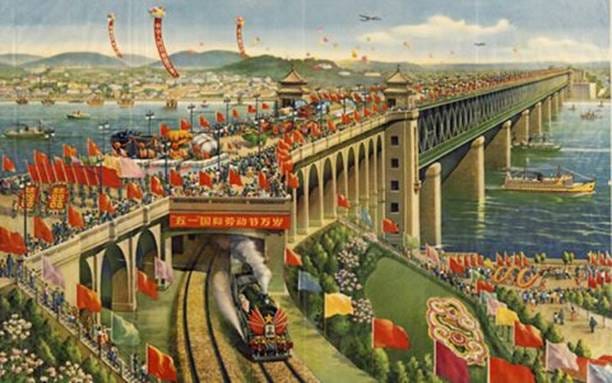
China first Five-Year Plan (1953-1957) emphasized rapid “smokestack” industrialization, with a primary focus on steel, coal, cement, power generation, machinery production and infrastructure. It was directly modelled on the Soviet central planning approach.
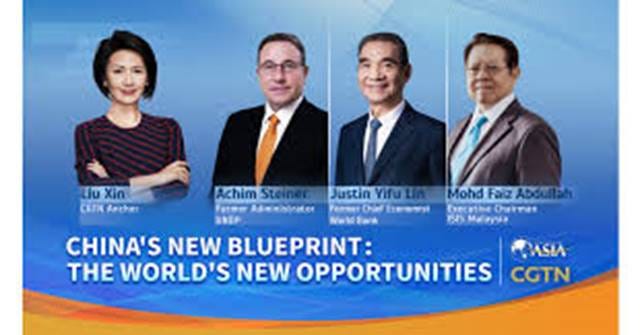
The recently approved 15th Five-Year Plan (2026-2030) exhibits a critical emphasis on advanced technological development and self-reliance. According to the World Economic Forum, it, “signals a new phase of strategic adaptation.” Yet one can still see how this new blueprint is underpinned by all the implemented plans that preceded it.
Moreover, this fresh plan is embedded within the framework created by the four pivotal global initiatives announced by China over the last several years: the Global Development Initiative (2021). The Global Security Initiative (2022), the Global Civilizational Initiative (2023), and the Global Governance Initiative (2025).
This set of broad interlocking proposals, with their unwavering, globally inclusive focus is unlike any framework previously generated during the long period of imperially-sourced, Western world leadership.
This comparative actuality was captured in an acute observation by the prominent commentator, Pankaj Mishra, about six months ago. After noting that “there is much that is imperfect about China,” Mishra argued how “China is a very different kind of late modernising power that is setting an example that there are other ways of being a powerful country in the world” (see:
).
Finally, it is helpful to consider some timely observations by Harvard’s Professor Stephen Walt. He recently argued that: “The second Trump administration has been far more disruptive, damaging, and dangerous than most observers – including me - expected, and the tragically inept war with Iran is driving that point home in spades.”
Walt then advised how the White House should remedy this dire focus: “A far-sighted great power will use its power with restraint, adhere to widely held norms whenever possible, recognize that even close allies will have their own agendas, and work to fashion arrangements with others from which all parties benefit” (see: https://www.washingtonpost.com/ripple/2026/03/26/united-states-trump-rogue-state-iran/).
It is fair to wonder if Professor Walt may have had China in mind as he crafted this rectification formula as it essentially summarizes Beijing’s settled, distinctively globalized approach to managing China’s geopolitical interactions.
Conclusion
Looking forward, Beijing clearly expects that its best interests will be served – and mutual benefits will arise- when China positions itself as a fundamental anchoring nation operating within a fully interactive, multi-polar world. This is the promising – and challenging – context within which Hong Kong, Asia’s World City, will need to craft its first five-year plan. This plan will also have to be developed and applied bearing in mind the way it will lay down crucial foundations for five-years plans to follow.
Completing this demanding, multi-faceted task will test the SAR significantly. The positive opportunities are remarkable, however. And the exceptional success of so many past strategic development interventions confirm how adept Hong Kong is when it applies itself assiduously to long-term planning and execution tasks.
This is a mildly revised version of an article originally published in the China Daily on April 12, 2026 (see: https://www.chinadailyhk.com/hk/article/631846).