

This article may be freely republished with appropriate attribution
Introduction
Present awful circumstances emphasize the need to ask a serious question: how unhinged is America today?
In fact, this central query has been posed by a range of leading commentators for several years. Today it is being asked more urgently. While Israel and the US apply the finishing touches to their Gaza genocide, the world is watching after America and Israel unleashed fresh spasms of massively destructive warfare in the Middle East.
The unhinged narrative
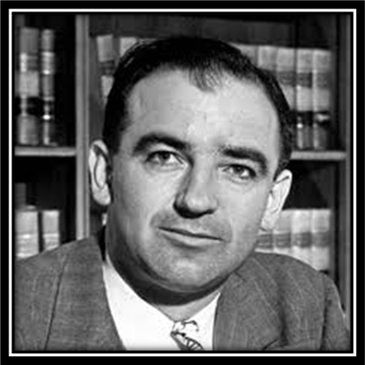
Three years ago, in March 2023, Fareed Zakaria was already urging the Biden administration, in The Washington Post, to step firmly away from a foreign policy, “forged out of paranoia, hysteria and above all fears of being branded as soft”. Zakaria also compared this prevailing deranged mood to the America’s notorious, 1950s, witch-hunting McCarthy era (see: https://johnmenadue.com/post/2023/03/the-return-of-the-paranoid-american-foreign-policy/).
At about the same time, The Guardian argued how QAnon and Donald Trump, together, had “unhinged America.” More recently, Bridget Delaney, in the same newspaper, identified President Trump, alone, as being responsible for the unbalanced aura surrounding the US, when she argued how, “The world is gripped by 3am dread thanks to an unhinged US president”(see: https://www.theguardian.com/commentisfree/2026/apr/13/the-world-is-gripped-by-dread-trump-unhinged).

A large and growing number of similar estimates of deluded America behaviour- often stressing malign Israeli influence – can now be found across a wide range of media outlets in the Global West and well beyond (see:
).
What if China had not soared economically
These arguments are fundamentally right. But they also prompted me to wonder what the geopolitical impact on America might have been had China failed to rise as remarkably as it has.
Forget for a moment the fact that prominent commentator, Gordon G Chang, has locked in a remarkable record for wrongly predicting the collapse of China. Suppose, instead, that Chang had been right in 2001, when he published “The Coming Collapse of China” predicting a pivotal political-economic downfall by 2011.
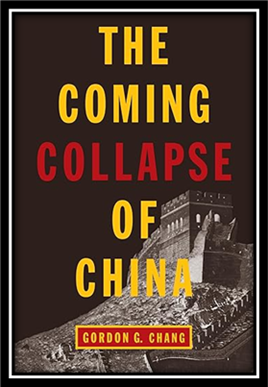
What if China had buckled in the drastic way Chang foretold and the US had not faced such a formidable, advancing peer competitor, over whom it lacked the sort of controls previously used to manage such challenges (like those applied to Japan in the 1980s). Might the world have been spared the spectacle, today, of seeing the US transform itself into a brazen, globally menacing hoodlum democracy, doing Israel’s bidding? (see: https://fridayeveryday.com/saving-whats-left-of-western-liberalism/).
My considered view is that, had China failed to rise so conspicuously, America may have been somewhat less anxiety-ridden, and it may have been marginally less obsessed with the need to resort to constant war mongering in order to reassert its perceived, fading virility.
However, it would still have been exceptionally menacing to all nations that failed to demonstrate sufficient obedience, and it most likely would have been even more globally threatening. Moreover, America itself has supplied compelling evidence confirming the cogency of this perspective.
America’s appalling response following the end of the Cold War
In November 1989, the Berlin Wall came down. By the end of 1991, America’s paramount Cold War foe, the USSR had collapsed. The following year, The New York Times revealed a crucial, new detailed American proposal to secure indefinite American global supremacy. This secret, Washington incubated 1992 plan, promising “full-spectrum global dominance,” was designed to ensure that no other nation could ever challenge American hegemony again (see: https://fridayeveryday.com/the-shameless-new-washington-consensus-is-drenched-in-blood/).
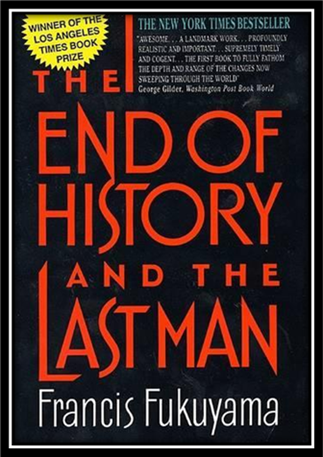
At about the same time, the influential US political scientist, Francis Fukuyama, argued how the remarkable historical process (outlined above) demonstrated that American-led, Western liberal democracy had evolved as the final form of government for all nations around the globe. Soon after he published a book entitled: The End of History and the Last Man.
Bad consequences soon followed.
Professor John Mearsheimer, in 2014, confirmed how the EU, by the mid-1990s, cemented the existence of a highly aggressive, new Washington Consensus, after recklessly signing up to a drastic US-led, geopolitical thrust into Eastern Europe to bring Russia to its knees. He argued that:
According to the prevailing wisdom in the West, the Ukraine crisis can be blamed almost entirely on Russian aggression. Russian President Vladimir Putin, the argument goes, annexed Crimea out of a long-standing desire to resuscitate the Soviet empire.
But this account is wrong: the United States and its European allies share most of the responsibility for the crisis. The taproot of the trouble is NATO enlargement, the central element of a larger strategy to move Ukraine out of Russia’s orbit and integrate it into the West. For Putin, the illegal overthrow of Ukraine’s democratically elected and pro-Russian president—which he rightly labeled a “coup”—was the final straw. He responded by taking Crimea, a peninsula he feared would host a NATO naval base.
This grim catalogue has grown apace ever since. In early January, in “New war and peace,” I detailed America’s enduring, war-mongering pedigree and explained how it stood behind the wanton use of concentrated, homicidal America military force in Latin America, adding that America appears locked inside a 200 year time-warp, where it cannot move beyond a default habit of imposing its will on other nations by military force or other profoundly coercive means in order to secure a menacing American version of peace (see: https://www.chinadailyhk.com/hk/article/626357?utm_source=substack&utm_medium=email).
Most recently we have witnessed the on-off-on-again horror story of vindictive US-Israeli wars-of-choice against Iran. These have ultimately played havoc with the entire global economy. The first huge joint attack on Iran in July 2025 was preceded by audacious America treachery, where agreed negotiations were used to put Iran of guard (see: https://www.chinadailyhk.com/hk/article/616797). The latest major brutal onslaught began with America killing over 100 Iranian primary school students coupled with a mass Iranian leadership assassination project, which the two war-makers cast as a form of advanced statecraft (see https://responsiblestatecraft.org/larijani-killed-israel/) .
Around a year ago, China, alone amongst major trading nations, went toe-to-toe with the US after the White House delivered what The Economist called “Donald Trump’s tariff tantrum” (see: https://www.economist.com/business/2025/04/16/the-trade-war-may-reverse-hong-kongs-commercial-decline). All the world noticed how China subsequently secured a tariff truce with Washington.
The Washington Post recently confirmed America’s contempt for long-term, close allies, when it reported how Thailand had openly expressed significant disappointment with the US failure to offer direct help to Bangkok as it struggled with “severe fallout from the ongoing Iran war.” Thailand subsequently turned to China and Russia seeking assistance (see: https://www.indiatoday.in/world/story/thailand-turns-russia-china-after-us-offers-no-help-on-iran-war-fallout-2902918-2026-04-28).
Conclusion
It is evident that:
· The Rise of China has amplified American hegemonic-paranoia – as argued by Zakaria and others.
· What has been unleashed under President Trump (elected through voting shaped by that paranoia) is a terrible, fresh willingness to attack and bomb and destroy and kill anyone selected as a primary US foe.
· Israel’s influence has been exceptionally powerful in the US – and caustically unconcerned – in supporting this intensifying, hoodlum form of statecraft.
Over 30 years ago, China was only the 11th largest economy in the world with a GDP of around $500 billion (compared to around $18 trillion today). China was then regarded by the massively larger US economy as a hopefully converging, but relatively small-scale promising economic opportunity (see: https://johnmenadue.com/post/2025/11/australian-universities-and-china/).
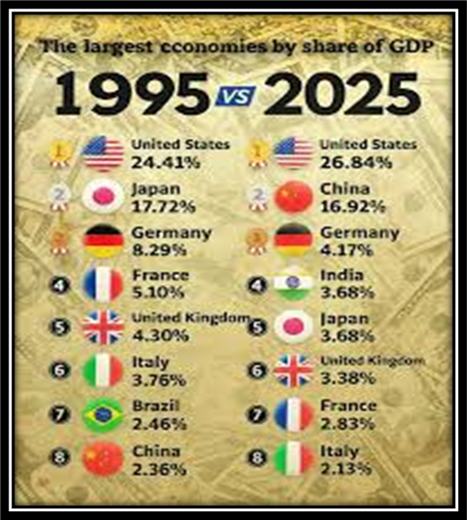
Thus, America’s readiness to abuse its huge imperial power was confirmed (by Washington’s 1992, post-Cold War, full-spectrum global dominance plan) at a time when China posed no visible “rising-peer threat” to the US.
Fortunately for the world, the extraordinary, peaceful rise of China has since provided a massive, stabilizing counterweight as America has become more destructively unhinged. For almost half a century China has maintained an exceptionally positive, let’s go to work focus on the future. This has been immensely beneficial for China – and that is certainly Beijing’s priority. But it has also been singularly good for the entire world (see: https://michaelwest.com.au/china-or-america-who-is-the-warmonger/).
The prominent American commentator, Ray Dalio, lately observed how China’s future global, superpower profile looks set to be pivotally shaped by what might be termed geopolitical Confucianism. Dalio believes China’s continued, commanding rise will be anchored within its historically embedded worldview: other smaller states are expected to show respect but, equally, China is obliged to behave well when dealing with less-powerful countries. This perspective fundamentally shuns the idea that such interaction needs to rely on the creation and maintenance of several hundred highly-armed, worldwide military bases (see:
).
Remarkable endorsement of this more positive, Western view of China was evident in a fresh Francis Fukuyama, interview where he confirmed, implicitly, that history had re-started and explicitly, that China’s system works – and appears to be working better in certain respects than that in the US (see:
) .
Finally, during this extremely disruptive period, the great majority of nations (in the Global South and well beyond) are increasingly emphatic when they say thank goodness for China. Even across the Global West – outside of the US - most are now quietly but firmly expressing the same view.