

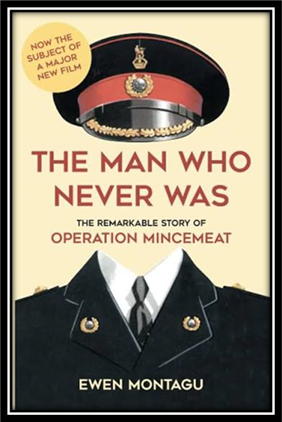
The Remarkable Story
The British practice of naming certain military projects, “operations” dates back to World War I. The term was chosen to stress military priorities, including security, a clear tactical focus, resource planning and coordination. And to provide a distinctive, shorthand title.
According to the Imperial War Museum (see: https://www.iwm.org.uk/history/second-world-war/intelligence/the-war-on-paper-operation-mincemeat):
Operation Mincemeat was a deception conceived by British Intelligence to fool the Germans regarding the true target for the Allied invasion of Sicily. A dead body would be ‘planted’ off the coast of Spain carrying secret documents which purported to reveal that the targets for the forthcoming invasion would be Greece and Sardinia, with Sicily only intended as a feint. To ensure that the Germans swallowed the deception, it was necessary to create a detailed false identity for the body, which was that of a homeless labourer who had died after swallowing rat poison.
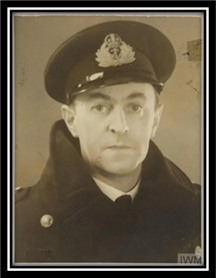
Portrait photo of Captain Ewen Montagu (Royal Naval Reserve). Montagu was a naval intelligence officer who played a leading role in devising Operation Mincemeat, together with Squadron Leader Charles Cholmondeley (Royal Air Force Volunteer Reserve).
The secret operation involved dressing this corpse as a Major in the Royal Marines and giving it the false identity of ‘William Martin’. Appropriate identification documents and other papers would give the body a personality and background. These included a photograph of Major Martin’s fiancée, a receipt for an engagement ring, a theatre ticket stub and other evidence.
Early on 30 April 1943, the body of ‘Major Martin’ was launched into the sea from the British submarine HMS Seraph and left to drift just over a mile off the southern Spanish coast. Once recovered by the Spanish authorities, the ‘secret’ documents carried on the body were covertly opened, photographed and passed via Nazi sympathizers to German intelligence officers in Spain.
Also, according to the Imperial War Museum:
The Germans acted swiftly on the false information by doubling the number of troops sent to Sardinia, while many additional German divisions were also transferred to Greece and the Balkans. The Allied Invasion of Sicily was launched on 9 July 1943 and, as intended, proved a huge surprise to the German defenders. In just over a month the island was fully captured by the Allies, and the lack of enemy reinforcements had proven to be a deciding factor in the success. ‘Mincemeat’ had been well and truly swallowed.
Some have questioned whether the British deception was this convincing. One writer has argued that the Abwehr (German Military Intelligence) knew that Major Martin’s confidential papers were not authentic but played a critical role in convincing Hitler that they were:
The Abwehr officer in Berlin who was the ultimate authority on the authenticity of the documents and was Hitler’s favourite intelligence analyst was easily able to detect the phoniness of “Martin’s” papers. But he chose to reassure Hitler because he was a dedicated anti-Nazi. He was prepared to do anything to help the Allies win the war. In fact, many in the Abwehr were anti-Nazi. The boss, Admiral Wilhelm Canaris, was later executed in the wake of the failed von Stauffenberg assassination plot (see: https://malwarwickonbooks.com/truth-about-operation-mincemeat/).
Even if this assertion is correct, without the deceptive transit of Major Martin to that Spanish beach, there would have been nothing for the Abwehr to work with.
A Singular Book
Less than 10 years after the invasion of Sicily, a former British cabinet minister Duff Cooper, wrote a spy novel in 1950 which knowingly drew on facts evident in Operation Mincemeat. The British intelligence services decided it would be sensible to put the record straight, as they saw it, and, with their sanction, Ewen Montagu wrote, within a two-week period, his own telling of the relevant events in his novel: “The Man Who Never Was.” It was published in 1953 and went on to sell 2 million copies. It was made into film with the same name in 1956 (https://en.wikipedia.org/wiki/The_Man_Who_Never_Was_(book).
The First Film
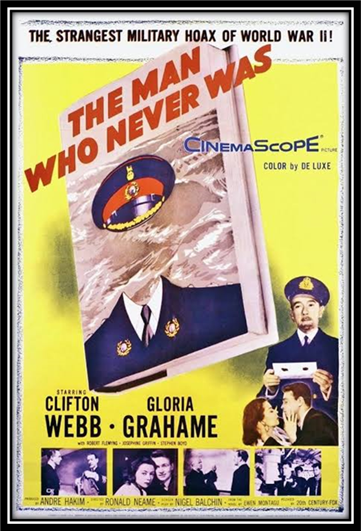
Clifton Webb starred as Ewen Montagu. Gloria Grahame was Lucy Sherwood, who shared a flat with Montagu’s assistant, Pam (Josephine Griffin). Lucy, without being privy to the project, becomes, at the planning unfolds, the “girlfriend” of Major Martin. In a contrived plot-twist, Stephen Boyd plays an Irish spy working for the Nazis sent to test the authenticity of Martin (after the secret papers have been reviewed in Berlin) by visiting Lucy.
The film, which runs for about 100 minutes, is very good. It remains fundamentally attentive to the development and execution of the deception. The film does an estimable job of retelling the essence of Operation Mincemeat in a measured, absorbing way.
The screenplay won the BAFTA award for 1956. One fictional character who plays a significant role in the film is Lt. George Ayres. This person appears to be based on Charles Cholmondeley. Cholmondeley’s identity remained a secret at the time the film was made (see: https://en.wikipedia.org/wiki/The_Man_Who_Never_Was).
The Second Film
“Operation Mincemeat” was released in 2021, 65 years after the first film. It is based on a book from 2010 by Ben Macintyre using the same title. Macintyre, trained as an historian, has written a number of well-regarded books and novels with espionage themes.
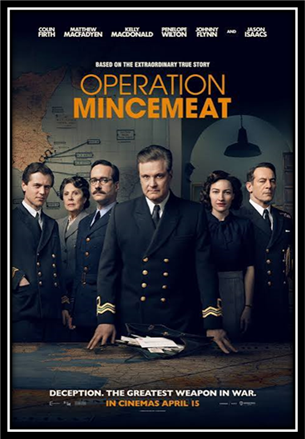
This film provides another robust narration of the same remarkable story.
The running time is almost half an hour longer. The more modern feel of the later film is evident. Significantly more time is devoted to examining stresses arising from (speculated) interpersonal, romantic and professional relationships, each shaped by involvement with Operation Mincemeat. This time Charles Cholmondeley is featured (under his own name) as a key participant.
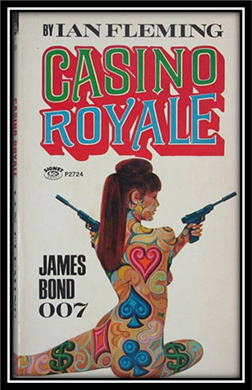
The required approval from Churchill for this exceptional project is explained along with the role of Ian Fleming in shaping the development of Operation Mincemeat at that time. Fleming, the creator of James Bond, worked for British Naval Intelligence during the war. The first Bond novel, “Casino Royale” was published in 1953 (see: https://www.goodreads.com/en/book/show/3758.Casino_Royale).
Which is the Better Film
It is now possible to compare the films without difficulty: both are available on DVD, for example.
Opinions will differ. Some may find the 1956 version somewhat stiff – and insufficiently blessed with engaging dramatic sequences designed to lift the level of emotional authenticity.
I found both films highly watchable.
But I preferred the crisply dominant focus, in the first film, on the complex, innovative development and execution of the deception exemplified in Operation Mincemeat.
And there are other aspects which helped make it a better film.
First, timing and the immediacy. The film was completed a little over a decade after the events depicted. All the leading actors had lived through the war as the real events unfolded. Plus, the book on which it was based had been written by the primary character in the actual narrative. Montagu’s choice of book title was exceptionally good and the film made the most of this and its first-mover advantage.
Next, the casting was first rate. Clifton Webb slipped into the Montagu role with customary, understated ease. If you are looking for someone, on screen, with near perfect diction and a continuously calm, emphatic presence, it is hard to think of anyone who could better Webb. Gloria Grahame also had a distinctive voice and striking presence. Her breathy phrasing was accompanied by a slight lisp.
And then there was Stephen Boyd. His substantial bearing and studied mannerisms projected exceptional creepiness as soon as he moved on screen as the (confected) Irish-Nazi spy. In 1956, there was, of course, no option to resort to foul language in a script to convey sinisterness but Boyd was in zero need of such assistance.

As I reflect on the two films, certain imagery arising from the 1956 film remains vividly clear in my mind. This is not the case with the later film.