The rail advantage
The dictionary definition of a tram is “a passenger vehicle that runs on rails laid along public streets” (see: https://www.merriam-webster.com/dictionary/tram).
The first trams were horse-drawn, originally introduced in New York City in 1832. Vehicles using metal wheels rolling on fixed rails provided a far better ride than horse drawn buses operating over unpaved or roughly paved streets. Moreover, pulling these early tram cars, a given team of usually two horses could pull far heavier loads, due to lower rolling-resistance compared to a horse-drawn wagon.
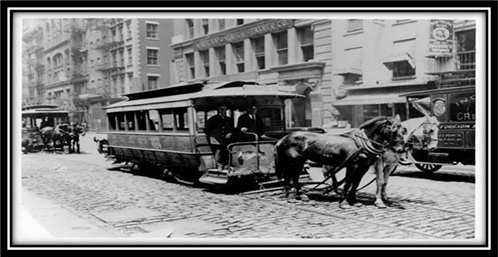
Horses, however, can only work for so long. Many were required to maintain a regular daily service. Plus, horses need to be carefully looked after on a daily basis.
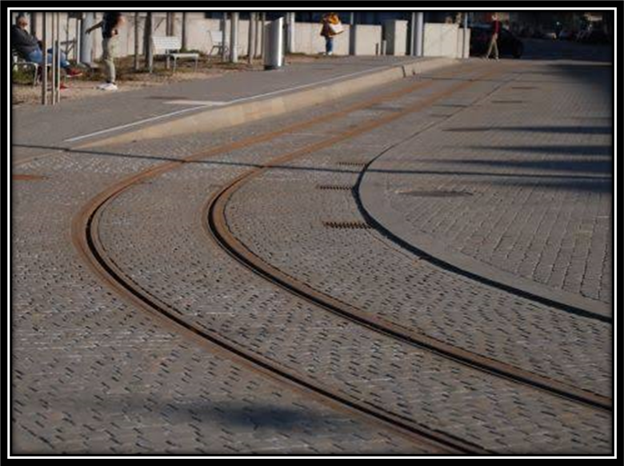
Meanwhile, installers of these early tramway systems realized that exposed, regular rail-tracks - with their tripping and obstruction problems - were a bad idea where streets were shared with people, horses and carts. Thus, the embedding of (light) rails within the roadway became the norm.
The search for alternative power sources continued. Steam-powered trams and even trams with internal combustion engines emerged but problems with configuration, refuelling, noise, pollution – and frightened horses - also emerged (see: https://case.edu/ech/articles/c/cleveland-newburgh-dummy-railroad). .
Two primary solutions
Cable Trams
Cable-pulled trams relied on gripping a continuously moving endless cable buried under – and accessible through – the road surface. Power came from a stationary steam engine located in a terminus base station.
This system delivered smooth, reliable power that was especially suited to operating trams on hilly terrains. Which helps explain how hilly San Francisco came to install the world’s first effective cable tram system in 1873.
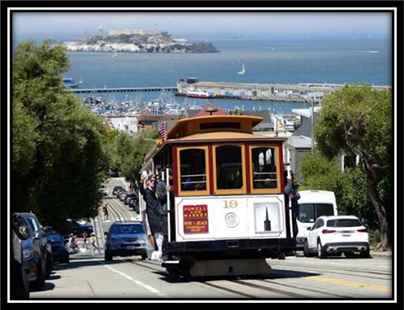
About a decade later, Melbourne began installing cable trams on a grand scale. Melbourne was mainly flat rather than hilly. But it had well-planned, uncommonly wide streets, well suited to building a cable tram network. The cable-trams were very popular and by the early 20th century, Melbourne had the largest cable tram network in the world with around 600 cable trams in operation providing a remarkably frequent service (see: https://www.abc.net.au/news/2025-11-10/140-years-since-first-cable-tram-melbourne/105988072).
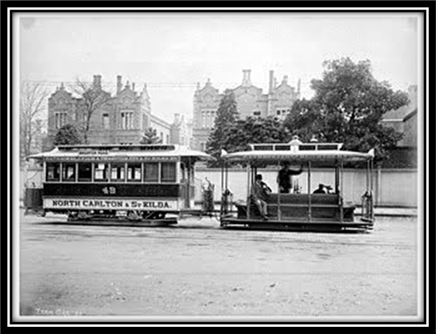
Cable tram systems require extensive, regular and awkward maintenance, however, far more so than electric trams. Melbourne’s last cable tram ran in 1940 (see below). Meanwhile, despite those maintenance challenges, hilly San Franscisco retained its cable trams.
As it happens, both San Francisco and Melbourne were booming cities in the second half of the 19th century as result of exceptional, proximate Gold Rushes (see: https://sovereignhilledblog.com/tag/california-gold-rush/).
Electric Trams
Once the challenge of delivering electric power reliably and safely to trams had been resolved, the performance superiority of electric trams compared to cable trams was confirmed.
The first regular electric tram services emerged in Europe and Japan in the 1890s. Extensive tramway systems were subsequently installed across many European cities (see: https://en.wikipedia.org/wiki/Tram).
Tramway (or streetcar) systems were widely adopted, at the same time, in the US and Canada and in Latin America. Tram services were also adopted more widely including in certain African cities, in India and in Asia (see: https://en.wikipedia.org/wiki/History_of_tram_and_light_rail_transit_systems_by_country).
The remarkable resilience of the Melbourne tram network
Establishing the network
Although an experimental electricity-powered tramline had been tried in Melbourne by 1889, due to the dominance of its cable tram network, Melbourne was slower than other cities to develop its electric tram network. Initially, new electric tramlines were built to connect to the cable tram network.
By 1919, the Melbourne and Metropolitan Tramways Board (MMTB), a public utility, was established. It soon took over the running of all tram-systems in Melbourne - cable and electric – and it initiated the steady conversion of the extensive cable tram network to electric traction. The last cable tram line was closed in 1940 (see: https://www.railtram.com.au/melbourne-tramway-history)
The MMTB was led, from the outset by men who were single-minded about:
· The value of the system they ran;
· The need to maintain it in good condition; and
· The need to protect it from all those who might undermine its continuity.
Protecting the network
The first chairman, Alexander Cameron (1919-1935) was followed by Hector Hercules Bell (1936 – 1949). They were followed by Major General Sir Robert Risson (1949 – 1970) (see: https://www.trammuseum.org.au/papers/heritage.htm).
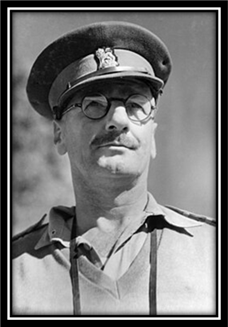
Around the globe, many tramway systems fell badly out of fashion after World War II and, outside of Eastern Europe, most were removed in North America, Europe and Australia. Trams were seen as a menace by the rapidly increasing number of private car owners and buses were argued (not least by bus-makers) to be far more flexible, efficient and less obstructive (see: https://www.abc.net.au/news/2018-04-12/sydneys-original-tram-network-what-happened-curious-sydney/9610328).
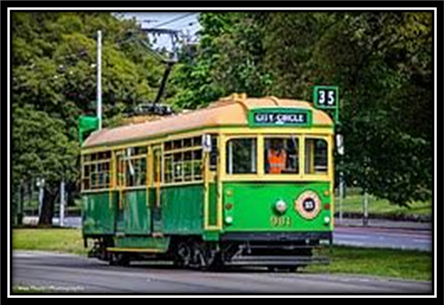
Sir Robert Risson was unyielding in his fiercely-reasoned hostility to this exceptional anti-tram movement. Unlike other tram networks, that run by the MMTB had been well maintained, even during the depression-era. The network was also blessed with a large fleet of proven, durable W2-class trams. Risson proved to be particularly effective in seeing off the political-economic challenge that the network faced in the 1950s and 1960s (see: https://www.trammuseum.org.au/papers/heritage.htm).
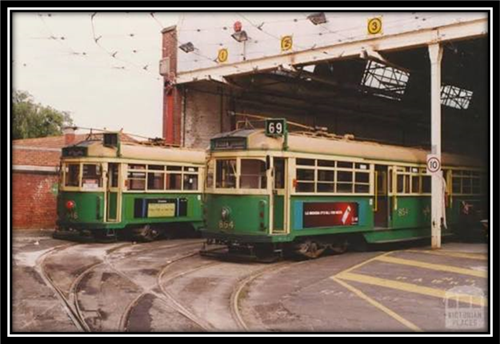
This achievement was recognized in one nick-name for those W2 trams: Major Risson’s Juggernauts.
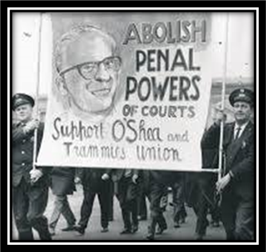
One of Australia’s pivotal industrial disagreements unfolded within the Melbourne tram-experience, also. This resulted in the last jailing in Australia, in 1969, of a trade union official, Clarrie O’Shea, for taking industrial action (refusing to pay fines imposed on the Australian Tramway and Motor Omnibus Employees’ Association in the course of an intense industrial dispute). This jailing, by Judge, Sir John Kerr (who later sacked Prime Minister Whitlam, as Governor-General, in 1975) triggered Australia’s largest postwar national strike (see: https://en.wikipedia.org/wiki/Clarrie_O%27Shea).
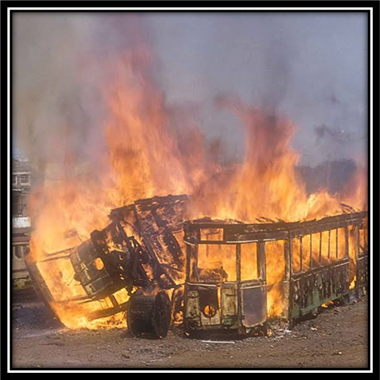
Ultimately, Robert Risson helped Melbourne dodge a bullet. Prior to the war, the Sydney tram network was measurably larger than the Melbourne tram system but it had been, comparatively, poorly maintained. By 1961, the entire, huge Sydney network no longer existed. Hundreds of trams were stripped and burned (see: https://www.abc.net.au/news/2018-04-12/sydneys-original-tram-network-what-happened-curious-sydney/9610328).
Over 30 years later, Sydney began rebuilding a tram system – now called a light-rail network – with the first new line opened in 1997. There are now four lines (with a total track length of almost 50 kilometres) and more are planned (see: https://en.wikipedia.org/wiki/Light_rail_in_Sydney).

Network influence
The impact of the network on daily life in Melbourne has been profound.
Two significant examples confirm this.
Prior to the emergence of shopping malls, one-stop, suburban strip-shopping dominated and the most extensive strip-shopping zones emerged along major tram routes. The longest of these, extending for around 8 kilometres, followed the Sydney Road tram route, which, passes through several inner suburbs,. It is the longest shopping strip in Australia (see: https://www.commercialrealestate.com.au/news/one-stop-shop-why-melbournes-iconic-sydney-road-strip-stays-in-front-1373148/).
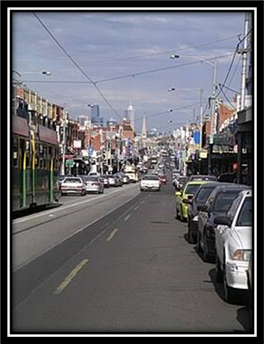
The network expanded as Melbourne grew. At the same time, Australian Rules Football developed rapidly. This local, fast-paced, football code was mainly played on large, cricket ovals (which removed the need for an offside rule). The introduction of the “8-hour day” work-regime enhanced the intense following of local teams on Saturdays. The tram network helped provide good access to many inner suburban grounds for thousands of deeply committed fans (see: https://www.trammuseum.org.au/papers/heritage.htm).
The largest tram system in the world
The operation of the Melbourne tram network was controversially privatized in 1999 (see: https://apo.org.au/sites/default/files/resource-files/apo-nid309595.pdf).
Notwithstanding the contentious nature of this policy change, the network has been continuously upgraded since then, with the addition of many multi-car, European-style trams and widely improved tram-stops throughout the network.
With a track length of around 260 kilometres, it is now the largest tram / light-rail -system in the world (see: https://en.wikipedia.org/wiki/List_of_largest_tram_and_light_rail_transit_systems).
There is a free city-circle tram plus all tram travel within the CBD (and nearby) is free (see: https://www.visitmelbourne.com/regions/melbourne/practical-information/getting-here-and-around/public-transport/city-circle-tram). .
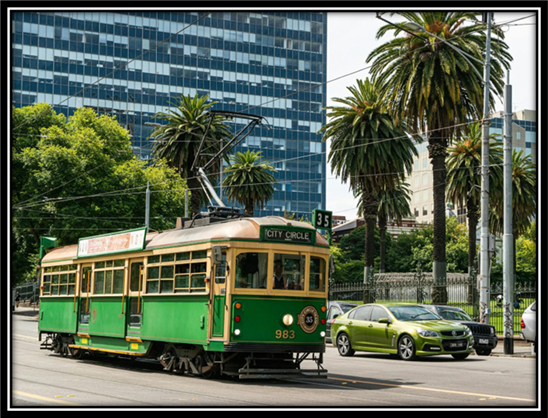
Substantial further extensions are planned (see: https://en.wikipedia.org/wiki/Proposed_Melbourne_tram_extensions).
Epilogue
The tram network - now over 140 years old - is emblematically important to Melbourne in a similar manner to the way the Tube System remains a primary signifier of the character of modern London.
Nadia Tass, a child of Greek immigrants to Melbourne, understood this particularly well. Her debut film as a director, in 1986, was the imaginative comedy-crime film “Malcolm,” where the tram network features as both: an essential element in the canvas of the film; and in plot development. It is where we also learned how to get two-for-the-price-of-one with an early Honda Z micro-car:

Colin Friels plays Malcolm, the splendidly tram obsessed, tramways employee - see:
As it happens, the West European city that I have visited most often, Vienna, has retained a marvellous tram network.
![Tramway, Ringstraße & Donauturm, Vienna, Austria. [Nellie] – Stick No Bills](https://substackcdn.com/image/fetch/$s_!vk6s!,f_auto,q_auto:good,fl_progressive:steep/https%3A%2F%2Fsubstack-post-media.s3.amazonaws.com%2Fpublic%2Fimages%2F8d863183-0aec-47f0-ab0f-03d7d20e7747_240x348.png "Tramway, Ringstraße & Donauturm, Vienna, Austria. [Nellie] – Stick No Bills")
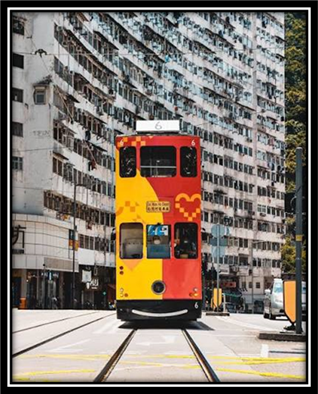
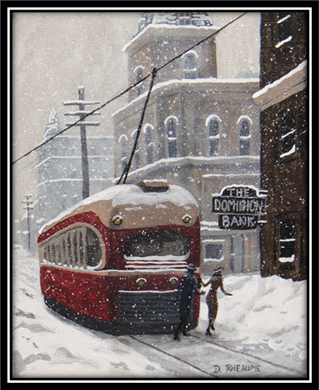
Coincidentally, the cities where I have lived longest, outside of Melbourne - Hong Kong and Toronto - have both retained their long-lived tram networks.